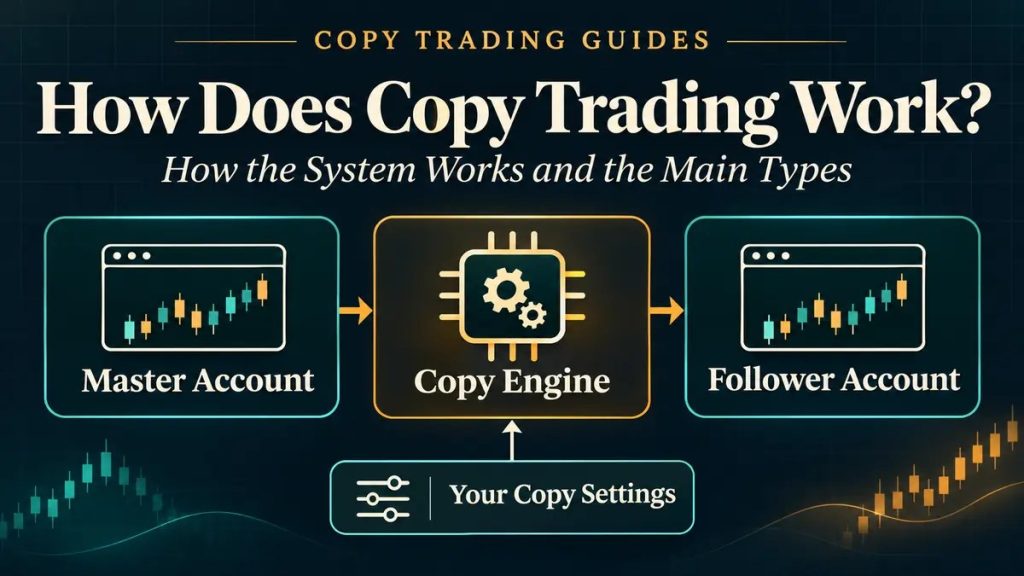
Copy trading lets you link your trading account to an experienced trader so that their trades are repeated in your account automatically. It sounds simple, but there are several different ways it can be set up, and each one works differently: where your money sits, who controls it, how trades reach your account and how you pay. This guide explains how copy trading works as a whole system, compares the main types, and shows what to check before you start.
New to the topic? Start with What Is Copy Trading? A Complete Beginner’s Guide. If you want to follow one copied trade step by step, including how lot sizes are calculated, read How Does Copying Professional Traders Work?
Quick answer: how does copy trading work?
Copy trading works by connecting two trading accounts through software. One account belongs to a Master (also called a signal provider or strategy provider) who trades with their own strategy. The other belongs to you, the follower. A copy engine, usually run by the broker or by a platform such as the MetaTrader 5 Signals service, watches the Master’s account and places matching orders in your account, scaled to your balance and settings. You keep your money in your own account, you can stop at any time, and the Master is usually paid a subscription or a share of the profits they make for you.
The four building blocks of copy trading
Whatever platform you use, every copy trading setup has the same four parts:
- The Master account. A real trading account where the Master places trades. Its history is the track record you judge the Master on, ideally verified by a third party such as Myfxbook.
- The follower account. Your own account at a broker, funded with your own money. This is where the copied trades open and where your profit or loss is recorded.
- The copy engine. The technology that links the two accounts. It reads every action on the Master account (open, modify, partial close, close) and repeats it on the follower account.
- Your settings. The rules you choose for copying: how much to invest, the copy mode or multiplier, and any loss limit. These decide how much risk you actually take.
Understanding these four parts makes it much easier to compare platforms, because the differences are almost always in who runs the copy engine and who holds the money.
The main types of copy trading
“Copy trading” is used as a general term for several models. Here are the ones you will meet most often:
1. Broker copy trading platforms
Many brokers offer their own copy trading service. The Master and the follower both have accounts at the same broker, and the broker’s system copies trades between them on the server side. You don’t need to keep any software running. You choose a Master in the broker’s copy trading area, set your copy mode and subscribe. This is the model used by the Masters on our Master Portfolios page.
2. MetaTrader 5 Signals
MetaTrader 5 has a built-in Signals service run through the MQL5 community. You subscribe to a signal, usually for a monthly fee, and trades are copied into your MT5 account even if it is at a different broker. Because copying happens through your MT5 terminal, the terminal must stay connected, which is why many subscribers use a virtual hosting service (VPS).
3. Trade copier software
A trade copier is a program or Expert Advisor (EA) that reads trades from one MetaTrader account and copies them to another. Traders often use copiers to run the same strategy across several of their own accounts. It is flexible but more technical, and it also needs a computer or VPS running 24 hours a day.
4. PAMM and MAM accounts
PAMM (Percentage Allocation Management Module) and MAM (Multi-Account Manager) work differently from copy trading. Investors’ funds are allocated to a money manager who trades them as one combined position, and profit or loss is shared in proportion to each investor’s capital. You don’t see individual copied trades in your own MT5 account in the same way, and you usually have less control over settings.
5. Social trading networks
Social trading platforms combine copy trading with a social feed, rankings and comments. The copying part works like a broker platform, but the emphasis is on browsing and comparing many traders.
Comparison at a glance
| Type | Where your money is | Software you must run | Your control | Typical cost |
|---|---|---|---|---|
| Broker copy trading platform | Your own account at the broker | None (server side) | High: copy mode, multiplier, stop at any time | Profit share or fee set by the Master |
| MetaTrader 5 Signals | Your own MT5 account | MT5 terminal or VPS | High | Monthly subscription |
| Trade copier / EA | Your own accounts | Copier on a PC or VPS | Very high, but technical | Software and VPS costs |
| PAMM / MAM | Allocated to a managed account | None | Lower: choose amount, deposit and withdraw | Performance and management fees |
How copy trading works on MetaTrader 5
On a broker copy trading platform for MT5, the process looks like this from your side:
- You open an MT5 account with the broker the Master uses, choosing the same account type (for example a standard or cent account).
- You subscribe to the Master on the broker’s copy trading page and choose your copy settings.
- The copy engine links the accounts. From that moment, new trades the Master opens are sent to your account automatically, usually within milliseconds to a second.
- You see every trade in your own MT5 app. Copied positions appear in your terminal like any other trade, with their own entry price, stop loss and profit or loss.
- Results settle in your account. When the Master closes a trade, your copy closes too and the result is added to your balance.
Because everything runs on the broker’s servers, copying continues while your phone or computer is off. The details of how each trade is sized are covered in our step-by-step guide.
What a typical month of copy trading looks like
- Week 1: You choose a Master after checking their verified history, deposit at least the recommended capital and subscribe.
- During the month: Trades are copied automatically. Some will win and some will lose. Your job is to check your results and the Master’s statistics from time to time, for example once a week, not to manage individual trades.
- End of the period: If the platform uses a profit share, the fee is calculated on the profit for that period. Many platforms use a high-water mark, so you only pay on new profits above your previous peak.
- Any time: You can add funds, withdraw profits under your broker’s normal rules, change settings or unsubscribe.
What decides your results
Copy trading is automatic, but your results depend on choices you make:
- The Master you choose. Look at verified return, maximum drawdown, how long the account has been running and how consistent the results are. Our guide on how to read Myfxbook performance shows what to look for.
- Your risk settings. A higher multiplier increases both profits and losses in the same proportion.
- Your capital. Depositing less than the Master’s recommended minimum can cause trades to be rounded up or skipped.
- Costs. Spreads, commissions, swaps and the Master’s fee all reduce your net return.
- When you start. Joining during a losing period can feel very different from joining during a winning streak, even with the same Master.
- Your own behaviour. Stopping after a normal loss and restarting after a big win is one of the most common ways followers end up with worse results than the Master. Our article on FOMO and chasing price explains why.
Risks of copy trading and how to manage them
Copy trading does not remove trading risk. It changes who makes the trading decisions. The main risks are:
- Market risk. Every strategy has losing trades and losing months. Past performance does not guarantee future results.
- Strategy risk. Some strategies, such as martingale or grid systems without stop losses, can show smooth profits for months and then suffer a very large loss. A low drawdown with a long history is usually a better sign than a very high return.
- Leverage risk. Copying at a high multiplier can turn a moderate drawdown for the Master into a large one for you.
- Master risk. A Master can change their style, take more risk or stop trading. Keep checking their statistics.
- Fraud risk. Be careful with anyone who asks you to send money to them personally or promises guaranteed returns. With legitimate copy trading, your money stays in your own account at a broker.
A simple safety checklist: choose Masters with a verified track record of at least several months, start at 1x or lower, never invest money you can’t afford to lose, use a loss limit if your platform offers one, and spread larger amounts across more than one Master.
Who is copy trading suitable for?
Copy trading suits people who want exposure to the Forex and gold markets but don’t have the time or experience to trade every day, and who are comfortable with the risk of losses. It is less suitable if you need guaranteed income, if you would be stressed by normal drawdowns, or if you want to learn to trade yourself. If you are deciding between the two, read Copy Trading vs Trading Yourself: Key Differences.
How to start copy trading with CopyTrade Scout
- Compare the Masters on our Master Portfolios page, including their verified performance, drawdown, broker and recommended capital.
- Open an account with the Master’s broker using the right account type.
- Press Start Copying on the Master’s page and subscribe on the broker’s copy trading platform.
- Check your account and the Master’s statistics regularly.
If you would like help, contact our team on WhatsApp, Telegram or LINE.
Frequently asked questions
Does copy trading work automatically?
Yes. Once you subscribe, new trades are copied without any action from you. On broker platforms copying runs on the broker’s servers, so your device can be switched off. With MT5 Signals or trade copiers, your terminal or VPS must stay online.
Is copy trading legal?
Copy trading is offered by many regulated brokers and is legal in most countries, but rules differ from country to country. Use a reputable broker and check the rules where you live.
Can I lose more than I deposit?
It depends on your broker. Many brokers offer negative balance protection, which stops your balance from going below zero. Check whether your broker offers it before you start.
Is copy trading passive income?
It is passive in the sense that you don’t place trades yourself, but it is not guaranteed income. Returns vary from month to month and losses are possible, so you still need to monitor your account.
How is copy trading different from PAMM?
In copy trading, trades are copied into your own account and you control the settings. In a PAMM, your money is allocated to a managed account and the manager trades the combined funds.
How much do I need to start?
Each Master has a recommended minimum so that trades can be copied accurately. Cent accounts let you start with a smaller amount. See each Master’s page for details.
Conclusion
Copy trading works by linking a Master’s account to your own account through a copy engine that repeats every trade at a size matched to your balance. The model you choose, whether a broker platform, MT5 Signals, a trade copier or a PAMM account, decides where your money is held, what software you need and how much control you keep. Once you understand those differences and the risks, you can choose a Master and settings that fit your goals.
Ready to compare Masters? Browse our Master Portfolios, read the FAQ, or contact our team.
Risk warning: Trading Forex and CFDs carries a high level of risk. Past performance does not guarantee future results, and you could lose all of your invested capital. Copy trading does not remove trading risk. This article is for educational purposes only and is not investment advice.