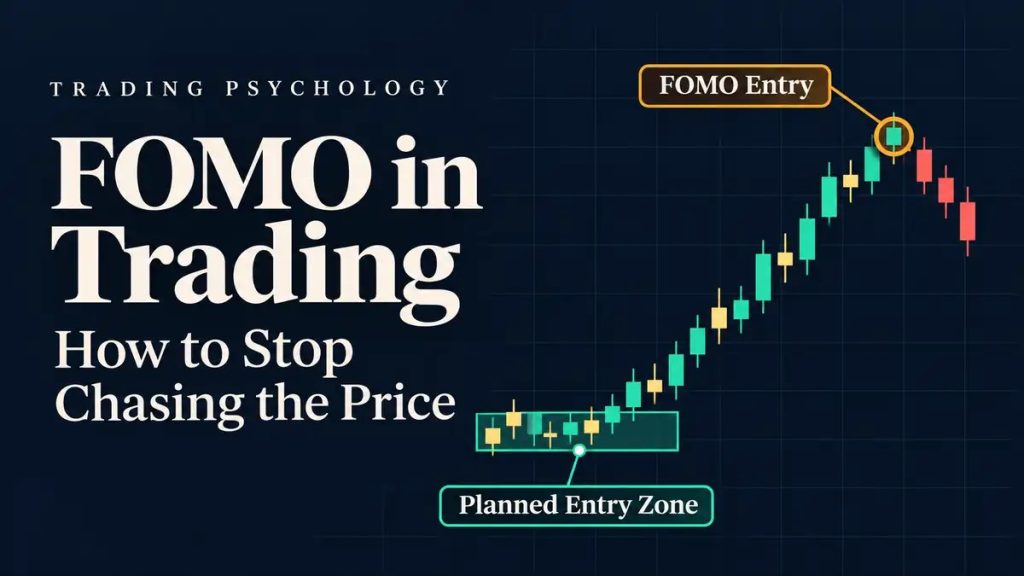
Have you ever watched gold or a currency pair shoot higher and thought, “If I don’t get in now, I’ll miss it”? You rush in near the top, the price turns straight away, and you end up cutting the loss or stuck in a bad position. This is FOMO (fear of missing out), and chasing the price because of it is one of the most common reasons traders lose money. This guide explains why we chase the market, the warning signs to watch for and practical ways to stop yourself.
Quick answer: how do you stop chasing the price?
To stop FOMO trading, define your entry zones in advance, use limit orders instead of emotional market orders, follow a simple rule that if price runs past your zone, you let it go, check risk-to-reward before every trade, and use a 5-minute wait rule before any unplanned entry. The market creates new opportunities every day. Missing one move is not a loss, but chasing a bad entry often is.
What is FOMO in trading?
FOMO is the fear of missing a profitable move. When price moves strongly and you are not in the trade, your brain treats it like a loss, even though you haven’t lost anything. That feeling pushes you to jump in without a plan or a stop loss, usually at the worst moment: after the move has already happened.
Chasing the price is what FOMO looks like on the chart: buying after a big rally or selling after a sharp drop, when the good entry has already passed.
Why do traders chase the price? 5 psychological reasons
- Greed and fear at the same time: you want the same profit others are making and fear the chance won’t come again.
- Social media pressure: seeing others post winning trades makes you feel left behind.
- Revenge trading: after a loss, you rush into the next trade to win the money back.
- No clear trading plan: without defined entries, every price move looks like an opportunity.
- Watching charts for too long: the longer you stare at the screen, the stronger the urge to click.
Warning signs that you are chasing the market
- You enter because “price is moving fast”, not because your setup has triggered.
- You trade without a stop loss, or with one that is far wider than usual.
- You increase your lot size because you are “sure it will keep going”.
- You feel rushed and anxious, as if a few seconds’ delay will cost you.
- You enter after a very large candle or after news has already been released.
- After closing the trade, you can’t explain why you took it.
The real cost of chasing trades
| Cost | What happens |
|---|---|
| Poor entry price | You buy high or sell low, close to where price often pulls back |
| Bad risk-to-reward | The stop loss must be wide while the remaining profit target is small |
| Bigger losses | Emotion leads to larger lots or no stop loss |
| Emotional cycle | A loss triggers revenge trading, which leads to more chasing |
| Broken discipline | When you keep breaking your plan, your system stops meaning anything |
8 ways to stop FOMO and chasing the price
1. Define your entry zones in advance
Before the session starts, mark the zones where you are willing to trade, such as demand and supply zones, support and resistance or liquidity areas. If price doesn’t reach your zone, you don’t trade. Professional traders work this way because decisions are made with a calm mind, not while price is racing.
2. Use limit orders instead of emotional market orders
Place buy limit or sell limit orders at your planned zones, with the stop loss and take profit set from the start. If price runs away without pulling back, simply cancel the order. You avoid making decisions when emotions are strongest.
3. Follow the “if it runs past my zone, I let it go” rule
Write this into your trading plan: if price moves away from your entry zone by more than a set distance, for example half of your stop-loss distance, that opportunity is gone and you wait for the next one. Letting go of trades that aren’t yours is a key skill of traders who survive long term.
4. Check risk-to-reward before every trade
Before you click, ask where your stop loss is and where your target is. If entering now gives a risk-to-reward below your minimum, for example 1:1.5, the trade isn’t worth it. Chasing almost always makes this number worse.
5. Use the 5-minute wait rule
When you feel the urge to take an unplanned trade, step away from the screen for 5 minutes, or write down your reason for entering. Most of the time the urgency fades, or price pulls back and the picture becomes clearer.
6. Limit your daily trades and daily loss
Set a maximum number of trades and a maximum loss per day. When you reach either limit, stop trading for the day. This breaks the “lose, then chase to win it back” cycle.
7. Keep a trading journal
Record every trade: why you entered, how you felt and what happened. Within a few weeks you will clearly see how much worse your FOMO trades perform than your planned ones. That evidence is the strongest motivation to stop.
8. Spend less time watching charts
The longer you watch, the more FOMO you feel. Set price alerts at your key zones and come back when price arrives. You will feel less stress and trade only the setups you planned.
Pre-trade checklist
- Is this trade in a zone I planned in advance?
- Do I know exactly where my stop loss and take profit are?
- Does the risk-to-reward meet my rules?
- Is my lot size in line with my money management plan?
- Am I entering because of my system, or because I’m afraid to miss out?
If the answer to any of these is “no”, let the trade go.
An option for busy traders or those who struggle with emotions
If you often chase trades or don’t have time to wait for planned entries, copy trading may be another option. Trades are copied from a Master who follows their own trading plan, so you don’t have to make entry decisions in emotional moments. Copy trading still carries risk, and you need to choose a Master carefully. Read Copy Trading vs Trading Yourself: Key Differences or browse our Master Portfolios.
Frequently asked questions
What does FOMO mean in trading?
FOMO (fear of missing out) is the fear of missing a profitable move. It makes traders enter impulsively without a plan, usually after a strong price move.
What should I do if I missed a move?
Let it go and wait for price to return to a new zone, or for the next setup. The Forex and gold markets offer new opportunities every day.
Do limit orders really help stop chasing?
Yes. You choose your entry price in advance with a calm mind, so you don’t have to click during emotional spikes.
Why does price reverse every time I enter?
Often because you enter after price has already moved a long way, when many traders start taking profit. Waiting for your planned zone helps avoid this.
Conclusion
Fear of missing out is human, but it can be controlled with a system. Plan your entry zones in advance, use limit orders, check risk-to-reward every time and accept that some moves are not yours to trade. When you stop chasing the price, you lose less, feel less stress and trade with more discipline.
Have questions? Read our FAQ or contact our team on WhatsApp, Telegram or LINE.
Risk disclosure: Trading Forex and CFDs involves a high level of risk. Past performance is not a guarantee of future results. You may lose all of your invested capital. This article is for education only and is not investment advice.