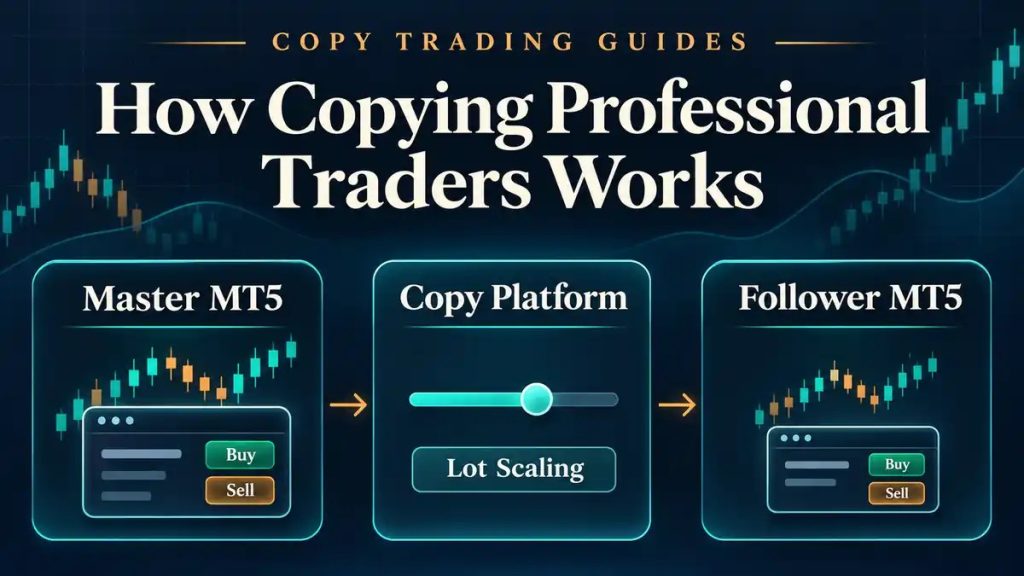
You have probably heard that you can “copy” a professional trader and let their trades run in your own account. But what actually happens behind the scenes? How does a trade travel from the Master’s MetaTrader 5 to yours, how is your lot size decided, and what are you really paying for? This guide explains the mechanics of copying professional traders step by step, so you know exactly what you are signing up for before you connect your account.
If you are completely new to the idea, start with our beginner’s guide What Is Copy Trading? first. This article goes one level deeper into how the process works.
Quick answer
Copying a professional trader works like this: the professional (called the Master or signal provider) trades their own live account. A copy trading platform, usually run by the broker, watches that account. Every time the Master opens, modifies or closes a position, the platform automatically sends the same instruction to your account (the follower or copier account) within a fraction of a second. Your trade size is scaled to your own balance using a copy ratio or copy mode that you choose. You keep control of your money, can stop copying at any time, and usually pay the Master a share of the profits only when you make money.
The three parties involved
Every copy trading setup has three parts:
- The Master (signal provider). An experienced trader who trades a real account with their own strategy and rules. Their results are public, often on a performance website such as Myfxbook.
- The copy trading platform. Software, usually provided by the broker, that connects Master accounts to follower accounts and duplicates trades automatically.
- You, the follower. You open your own trading account, deposit your own money and choose which Master to follow and how much risk to take.
An important point: your money never goes to the Master. It stays in your own account at the broker. The Master cannot withdraw your funds; the platform only has permission to place and close trades on your behalf.
How a trade is copied, step by step
Here is the life of one copied trade:
- The Master opens a position. For example, they buy 1.00 lot of XAUUSD (gold) on their MT5 account.
- The platform detects the trade. The copy system monitors the Master’s account in real time and sees the new position immediately.
- Your trade size is calculated. The platform converts the Master’s 1.00 lot into the right size for your account, based on your balance and copy settings (explained below).
- The trade opens in your account. A matching buy order on XAUUSD is sent to your account, usually within milliseconds to a second.
- Changes are mirrored. If the Master moves the stop loss, adds a take profit, closes part of the position or adds another order, the same changes happen in your account.
- The Master closes the trade, and so do you. When the Master exits, your position is closed automatically and the profit or loss is added to your balance.
You don’t need to be at your computer for any of this. That is why copying professional traders appeals to people who don’t have time to watch charts.
How your lot size is decided: copy modes and ratios
This is the part most beginners misunderstand. You do not copy the Master’s exact lot size; you copy their trades in proportion to your account. Platforms use different names, but the common copy modes are:
- Proportional (equity ratio). Your lot size is scaled to the ratio between your equity and the Master’s equity. If the Master has $10,000 and opens 1.00 lot, and you have $1,000, you would open about 0.10 lot. Your risk in percentage terms is roughly the same as the Master’s.
- Multiplier. You copy at a fixed multiple of the proportional size, such as 0.5x (half the risk) or 2x (double the risk). This lets you take more or less risk than the Master.
- Fixed lot. Every copied trade opens with the same lot size you set, regardless of the Master’s size. This is simple but can break the Master’s money management, because their larger and smaller trades all become the same size in your account.
For most people, proportional copying at 1x or lower is the safest starting point, because it keeps your risk in line with the Master’s track record. If the Master has a maximum drawdown of 10%, your account should see a similar percentage drawdown at 1x, and about double at 2x.
Minimum lot sizes matter. Brokers usually have a minimum trade size, such as 0.01 lot. If your account is very small compared with the Master’s, some trades may be rounded up to the minimum, which increases your risk, or skipped completely. This is one reason some Masters trade on cent accounts, where balances are shown in cents so small accounts can still copy accurately.
A simple example
Imagine a Master with $20,000 in equity who opens 2.00 lots of EURUSD and makes a 3% gain on the account that week.
- You copy proportionally at 1x with $2,000. Your trade opens at about 0.20 lot. If everything executes at the same price, you also gain about 3%, or $60.
- You copy at 0.5x. Your trade opens at about 0.10 lot and you gain about 1.5%, or $30.
- If the Master had lost 3% instead, you would lose about $60 at 1x and $30 at 0.5x.
The percentages are approximate. Your real results can differ slightly because of execution speed, spreads, slippage, fees and rounding of lot sizes.
Why your results can differ from the Master’s
Copying is automatic, but it is not a perfect mirror. Small differences come from:
- Execution delay and slippage. Your order is placed a moment after the Master’s. In fast markets, such as during big news, your entry or exit price can be slightly different.
- Spreads and commissions. Your account type may have different trading costs from the Master’s.
- Lot rounding. Very small accounts may have trades rounded up, rounded down or skipped.
- When you start. If you start copying in the middle of the Master’s losing period, your results will look different from someone who started earlier. Many platforms only copy new trades after you connect, not positions that were already open.
- Your own changes. If you close a copied trade manually or change the settings, your account will no longer match the Master’s.
How you pay the Master
Professional traders who share their trades usually earn from the people who copy them. Common models are:
- Performance fee (profit share). The Master receives a percentage of the profit you make, for example 20% to 30%, calculated over a set period such as weekly or monthly. You pay nothing in a period where you don’t make a profit.
- High-water mark. Many platforms only charge a performance fee on new profits. If your account falls and then recovers, you don’t pay again until it rises above its previous peak.
- Subscription or volume-based fees. Some platforms charge a fixed monthly fee or a small amount per lot traded instead.
Always check the fee structure of the Master you want to copy before you start. Each Master on our Master Portfolios page shows their broker, account type, minimum deposit and profit share.
What you stay in control of
Copying a professional doesn’t mean giving up control. As a follower you can usually:
- Choose the Master based on their verified track record and drawdown.
- Set your risk through the copy mode, multiplier or the amount you deposit.
- Use a protection limit, such as a maximum loss or equity stop, if your platform offers one. If your account falls to that level, copying stops.
- Pause or stop copying at any time, and close open positions if you wish.
- Withdraw your money from your own broker account whenever you want, subject to the broker’s normal rules.
How to start copying a professional trader on MT5
- Pick a Master whose strategy and risk level suit you. Learn how to read Myfxbook performance so you can check their verified results, drawdown and consistency.
- Open an account with the same broker the Master uses, with the right account type (for example a standard or cent account).
- Deposit at least the recommended minimum so that lot sizes can be copied accurately.
- Connect to the Master through the broker’s copy trading page and choose your copy settings. Start with proportional copying at 1x or less.
- Monitor your account regularly. You don’t need to watch charts, but you should check your results and the Master’s statistics, for example once a week.
If you would like help getting set up, our team can guide you through each step.
Common misunderstandings
- “The Master controls my money.” No. Your funds stay in your own account. The platform can only place trades.
- “I will get exactly the same profit as the Master.” Not exactly. Percentages are usually close, but execution, costs and timing create small differences.
- “A bigger multiplier means more profit.” It also means bigger losses and a deeper drawdown. Risk rises in exactly the same proportion.
- “Professional traders don’t lose.” Every trader has losing trades and losing weeks. What matters is how they control risk over time.
Still deciding whether copying is better for you than trading on your own? Read Copy Trading vs Trading Yourself: Key Differences.
Frequently asked questions
Do I need trading experience to copy a professional trader?
No. The platform places the trades for you. However, you should understand the basics of risk, drawdown and lot sizing so you can choose a suitable Master and settings.
How fast are trades copied?
On most broker platforms, trades are copied within milliseconds to about a second. Small price differences can still occur in very fast markets.
Will trades that are already open be copied when I start?
Usually not. Most platforms only copy new trades that the Master opens after you connect. Check your platform’s rules.
Can I copy more than one Master?
Yes, on most platforms. Spreading your money across Masters with different strategies can reduce the impact of any one Master’s losing period, but it also needs more capital.
What happens if I stop copying?
New trades from the Master will no longer be copied. Depending on the platform, your open positions are either closed immediately or left for you to manage.
How much money do I need to start?
It depends on the Master and the account type. Each Master sets a recommended minimum so that trade sizes can be copied correctly. Cent accounts let you start with a much smaller amount.
Conclusion
Copying professional traders is a simple idea built on a clear process: the Master trades, the platform duplicates every action into your account at a size scaled to your balance, and you pay a share of profits when you make money. Once you understand copy modes, the reasons results can differ and the fees involved, you can choose a Master and settings with confidence instead of guessing.
Ready to compare Masters? Browse our Master Portfolios, read the FAQ, or contact our team on WhatsApp, Telegram or LINE.
Risk warning: Trading Forex and CFDs carries a high level of risk. Past performance does not guarantee future results, and you could lose all of your invested capital. Copy trading does not remove trading risk. This article is for educational purposes only and is not investment advice.