Before you copy a Master, you should know how they really trade. Myfxbook is one of the most popular websites for checking the track record of a Forex trading account, but its pages are full of numbers that can be confusing. If you don’t have time to watch charts every day, learning to read a Myfxbook page is the most useful 10 minutes you can spend before you start copy trading. This guide explains which numbers matter, what they mean and which warning signs to look for.
Quick answer
To read Myfxbook performance before copy trading, check five things: (1) that the track record and trading privileges are verified, (2) how long the account has been trading, (3) the maximum drawdown, (4) whether the equity line follows the balance line smoothly, and (5) whether the monthly gains are steady rather than driven by one or two lucky months. A high total gain alone tells you very little.
What is Myfxbook and why does it matter for copy trading?
Myfxbook is a free website that connects to a trading account (for example on MetaTrader 5) and publishes its statistics: gain, drawdown, trades, win rate and more. Because the data comes from the trading account itself, it is harder to fake than a screenshot.
For copy traders, this matters because you are trusting someone else to trade your money. When you copy trade, every trade the Master opens also opens in your account. A Myfxbook page lets you see how the Master has handled good and bad markets in the past, without having to watch the charts yourself.
Step 1: Check that the account is verified
Near the top of a Myfxbook system page you will usually see two verification labels:
- Track Record Verified means Myfxbook has confirmed that the trading history comes from a real account and has not been edited.
- Trading Privileges Verified means the owner has shown that they actually control and trade the account.
If these labels are missing, treat the results with caution. An unverified page may still be honest, but you cannot be sure the numbers are real or that the person showing them is the one trading.
Also check whether the account is real or demo. Results on a demo account are easier to achieve because there is no real money and no emotional pressure.
Step 2: Look at how long the account has been trading
Find the account’s start date or the age of the track record. A few weeks of great results can be pure luck. A longer history, ideally many months or more, shows how the Master handles different market conditions such as trends, ranges and major news events.
A short record is not automatically bad, but it means you know less. If the account is new, start with a smaller amount and watch it closely.
Step 3: Understand Gain vs Absolute Gain
Myfxbook shows two kinds of return, and beginners often confuse them:
| Metric | What it means | Why it matters |
|---|---|---|
| Gain | A time-weighted return that ignores deposits and withdrawals | Shows the performance of the strategy itself |
| Absolute Gain | Profit compared with the money deposited | Shows what the account actually earned |
| Daily / Monthly | Average gain per day or per month | Helps you set realistic expectations |
If Gain and Absolute Gain are very different, it usually means money was added or removed during the period. That is normal, but it is worth understanding. Above all, be careful with very high returns: a Master who made several hundred percent in a few months is almost always taking big risks.
Step 4: Check the drawdown (the most important number)
Drawdown shows the largest fall in the account from a peak to a low point, as a percentage. It answers a simple question: how much could I have lost at the worst moment?
For someone who can’t watch charts all day, drawdown matters more than gain. If a Master’s maximum drawdown is 40%, you should be ready to see your own account fall by a similar amount, and possibly more in the future. Ask yourself honestly whether you could stay calm through that.
A lower drawdown generally means the Master controls risk more carefully. Compare it with the gain: a strategy that earns 30% a year with a 10% drawdown is very different from one that earns 30% with a 60% drawdown.
Step 5: Compare the equity and balance lines
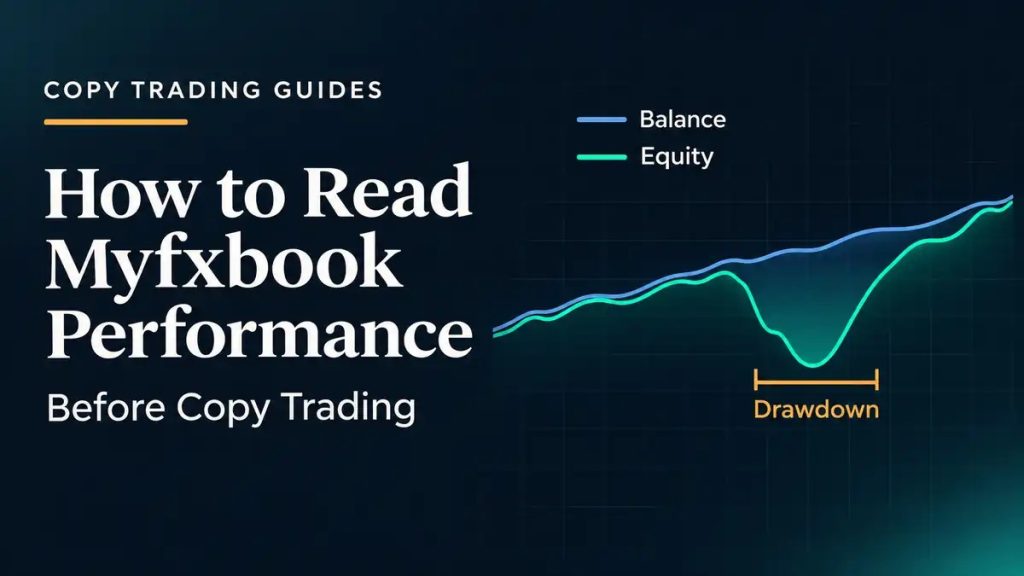
The Myfxbook growth chart can show both balance (closed trades only) and equity (including open trades). This is where many hidden risks appear.
- If equity stays close to balance, the Master usually closes losing trades and keeps risk under control.
- If the balance line rises smoothly but equity often drops far below it, the Master may be holding large losing positions open, averaging down or using a martingale or grid approach. These strategies can look very stable until one bad move wipes out the account.
A smooth balance line with deep equity dips is one of the biggest warning signs on Myfxbook.
Step 6: Review monthly returns for consistency
Open the monthly breakdown. You want to see results that are reasonably steady over time, with losing months that stay small. Watch out for these patterns:
- Most of the total profit came from one or two months.
- Large swings between big wins and big losses.
- Results that have been getting worse recently.
Losing months are normal for any real trader. What matters is how big they are and how the Master recovers.
Step 7: Read the trading statistics
The statistics section contains a lot of numbers. These are the ones most useful for copy traders:
| Statistic | What to look for |
|---|---|
| Number of trades | Enough trades to judge the strategy; a handful proves little |
| Win rate (Won %) | Useful only together with average win and average loss |
| Average win vs average loss | A very high win rate with tiny wins and huge losses is risky |
| Profit factor | Gross profit divided by gross loss; above 1 means profitable overall |
| Longest trade duration | Very long losing trades can mean losses are being held open |
| Lots and leverage | Sudden jumps in trade size can mean the Master is chasing losses |
A 90% win rate sounds impressive, but if the few losing trades are many times larger than the winners, the account can lose months of profit in one day.
Red flags to avoid
- No verification, or a demo account presented as real.
- Extremely high returns in a short time.
- Very high drawdown, or equity that often falls far below balance.
- Signs of martingale or grid trading, such as many open positions and growing lot sizes after losses.
- Gaps where the Master stopped sharing data, or a history that was restarted after a big loss.
- Promises of guaranteed or fixed profits. No honest trader can guarantee returns.
A 10-minute checklist for busy people
If you don’t have time to study every number, use this quick checklist before you follow any Master:
- Is the track record and trading privileges verified, on a real account?
- Has the account traded for long enough to see different market conditions?
- Is the maximum drawdown a level you could accept in your own account?
- Does equity stay reasonably close to balance on the chart?
- Are the monthly results fairly steady, with small losing months?
- Is the average loss under control compared with the average win?
- Are the returns realistic rather than too good to be true?
If the answer to most of these is yes, the Master is worth a closer look. You can then start with a small amount, use the copy trading settings to control your risk and review the results regularly.
Myfxbook is a tool, not a guarantee
Even a strong Myfxbook record only shows the past. Markets change, and a Master who performed well before can still lose money in the future. Use Myfxbook, or the statistics page provided by the broker’s copy trading platform, to filter out risky strategies, then manage your own risk with sensible capital and settings.
If you want to compare the effort involved, read Copy Trading vs Trading Yourself: Key Differences. When you are ready, browse our Master Portfolios to see each Master’s strategy, settings and live statistics.
Frequently asked questions
What is a good drawdown on Myfxbook?
There is no single right number, because it depends on how much risk you can accept. In general, a lower maximum drawdown means more careful risk control. Choose a Master whose worst drawdown you could live with in your own account.
Can Myfxbook results be faked?
Verified track records are much harder to fake because the data comes from the trading account. Unverified pages, screenshots and demo accounts are less reliable, so always check the verification labels.
Is a high win rate a good sign?
Not on its own. Always compare the win rate with the average win and average loss. A high win rate with occasional very large losses can be dangerous.
Do I still need to check the Master after I start copying?
Yes. You don’t need to watch the charts, but you should check the Master’s statistics and your own account regularly, for example once a week.
Conclusion
You don’t need to be an expert trader to read Myfxbook. Focus on verification, account age, drawdown, the equity chart and monthly consistency, and treat very high returns with suspicion. These checks take only a few minutes, and they can help you avoid the riskiest Masters before you commit any money.
Have questions? Read our FAQ or contact our team on WhatsApp, Telegram or LINE.
Risk disclosure: Trading Forex and CFDs involves a high level of risk. Past performance is not a guarantee of future results. You may lose all of your invested capital. Myfxbook is an independent third-party website and is not affiliated with this site. This article is for education only and is not investment advice.